

Discover the impressive fuel efficiency of the all-new 2026 Ford Explorer SUV
Fuel expenses are a big deal, whether you’re cruising Sarasota’s scenic roads or heading out on weekend trips across Florida. At Sarasota Ford, we’re eager to share all about the 2026 Ford Explorer MPG — a vehicle that offers both power and smart fuel economy.
The 2026 Explorer comes with two EcoBoost engine choices. The 2.3-liter four-cylinder engine makes 300 horsepower, while the 3.0-liter V6 produces 400 horsepower. Both engines work with a smooth 10-speed automatic transmission. A hybrid model also joins the lineup for those who want maximum efficiency.
Several factors affect your gas mileage — including trim level, equipment packages, engine choice, drivetrain, and how you drive. We’re here to guide you through all of it so you can choose the best Explorer for your lifestyle and budget.
2026 Ford Explorer MPG at a Glance
The 2026 Explorer’s best fuel economy comes from the 2.3L EcoBoost with RWD: 20 city / 29 highway / 24 combined MPG. The 3.0L EcoBoost V6 delivers up to 18 city / 25 highway / 21 combined MPG. The hybrid model is expected to exceed 28 MPG combined — the most efficient Explorer ever.
Key Takeaways
- Multiple EcoBoost powertrain options balance performance and fuel efficiency for different driving needs
- The 2.3L four-cylinder gets up to 29 MPG highway — one of the best ratings in the class
- The 3.0L EcoBoost V6 delivers 400 hp with still-competitive 25 MPG highway
- The hybrid model offers the biggest fuel savings, especially in city and stop-and-go driving
- Adding Intelligent 4WD reduces MPG only slightly — about 1–2 MPG in most configurations
Official 2026 Ford Explorer MPG Ratings
The 2026 Explorer has various configurations, each with its own fuel economy. Your choice of rear-wheel drive or Intelligent 4WD, along with the engine, affects your MPG. The table below covers all main configurations so you can compare at a glance.
2.3L EcoBoost RWD
20 city / 29 highway / 24 combined MPG — best fuel economy in the gas-only lineup
3.0L EcoBoost V6 RWD
18 city / 25 highway / 21 combined MPG — 400 hp with strong efficiency for its power
2.3L EcoBoost 4WD
20 city / 27 highway / 23 combined MPG — minimal MPG penalty for the added traction
Hybrid (Estimated)
~28+ combined MPG — the most fuel-efficient Explorer ever, especially in city driving
| Configuration | City MPG | Highway MPG | Combined MPG |
|---|---|---|---|
| 2.3L EcoBoost RWD | 20 | 29 | 24 |
| 3.0L EcoBoost RWD | 18 | 25 | 21 |
| 2.3L EcoBoost 4WD | 20 | 27 | 23 |
| 3.0L EcoBoost 4WD | 18 | 25 | 20 |
| Tremor 2.3L 4WD | 19 | 23 | 21 |
| Tremor 3.0L 4WD | 17 | 22 | 19 |
EPA estimates. Actual mileage will vary with options, driving conditions, and habits.

The 2026 Ford Explorer ST pairs bold styling with the powerful 3.0L EcoBoost V6 — available now at Sarasota Ford.
2026 Ford Explorer Engine Options & Fuel Economy
Choosing the right engine is key to finding the perfect Explorer for your lifestyle. Both EcoBoost engines pair with Ford’s advanced 10-speed automatic transmission, which optimizes gear selection for better efficiency. Auto Start-Stop Technology also helps by shutting off the engine at stoplights and restarting when you’re ready to move.
2.3L EcoBoost Turbocharged Four-Cylinder
The 2.3L EcoBoost engine is standard on Active, ST-Line, and Platinum trims with rear-wheel drive. It produces 300 horsepower and offers a genuine balance of power and efficiency — perfect for Sarasota families who want a capable SUV without high fuel costs. Its highway rating of 29 MPG makes long trips to Orlando or Tampa genuinely affordable.
| Driving Scenario | 2.3L EcoBoost Suitability | Key Advantage |
|---|---|---|
| Daily Commuting | Excellent | Best fuel economy in gas-only lineup |
| Family Transportation | Excellent | Adequate power with efficiency |
| Light Towing (under 3,500 lbs) | Very Good | Capable with minimal fuel penalty |
| Highway Road Trips | Excellent | Strong 29 MPG highway rating |
3.0L EcoBoost Twin-Turbo V6
The 3.0L EcoBoost V6 makes the Explorer truly quick — 400 horsepower, with acceleration that rivals sports sedans. Available on the Explorer ST and Platinum trims, it unlocks the full 5,600-lb towing rating. You’ll give up around 2–4 MPG compared to the four-cylinder, but many drivers find the extra capability well worth it.
For full specs on both engines, visit our 2026 Ford Explorer specs page.

The 2026 Ford Explorer’s spacious cargo area pairs with smart fuel efficiency — ideal for Florida family road trips.
2026 Ford Explorer Hybrid: The Fuel Efficiency Champion
We’re excited to introduce the most fuel-efficient Explorer ever — the 2026 hybrid model. It delivers impressive fuel economy without sacrificing the space, capability, or versatility the Explorer is known for. Available at Sarasota Ford, it’s a smart choice for Florida drivers looking to reduce fuel costs.
How the Hybrid System Works
The Explorer Hybrid pairs a gasoline engine with an electric motor and battery pack. Regenerative braking captures energy during deceleration and stores it for later use. The system switches seamlessly between electric and gas power — no plugging in, no changing your habits. It’s especially effective in city driving, where electric power handles low-speed operation quietly and efficiently.
Who Benefits Most from the Hybrid
City & Suburban Commuters
Stop-and-go traffic is where hybrid technology shines — regenerative braking turns every stop into a fuel-saving opportunity.
High-Mileage Drivers
At 20,000+ miles per year, the hybrid saves ~$395 annually vs. the base engine — savings that add up fast.
Florida Climate Drivers
Florida’s warm climate means no cold-weather battery concerns, and our mix of urban and highway driving is ideal for hybrid efficiency.
Hybrid owners in our area are already reporting 25–28 MPG in combined driving. The estimated annual fuel cost of ~$1,768 is nearly $300 less than the standard 2.3L model — over five years, that’s $1,500 in savings at current Sarasota fuel prices.
Real-World 2026 Ford Explorer Fuel Economy
At Sarasota Ford, we believe in transparency. EPA ratings are useful benchmarks, but your Explorer’s real-world fuel economy depends on how you drive. In Sarasota and Southwest Florida, Explorer owners are generally seeing fuel economy close to EPA estimates — and some beat highway estimates on long interstate runs.
Summer heat is the main variable to plan for. Running the air conditioning heavily can reduce efficiency by 2–4 MPG, which is normal in Florida’s climate.
| Factor | Impact Level | Potential MPG Change | What You Can Control |
|---|---|---|---|
| Driving Style | High | -30% to +10% | Smooth acceleration, gentle braking, steady speeds |
| Climate Control Use | Medium-High | -2 to -5 MPG | Moderate A/C settings, use recirculation mode |
| Traffic Conditions | High | -20% to -40% | Route planning, off-peak travel times |
| Tire Pressure | Medium | -1 to -3 MPG | Monthly checks, maintain recommended PSI |
| Cargo Load & Accessories | Medium | -1 to -4 MPG | Remove unnecessary weight, limit roof cargo |
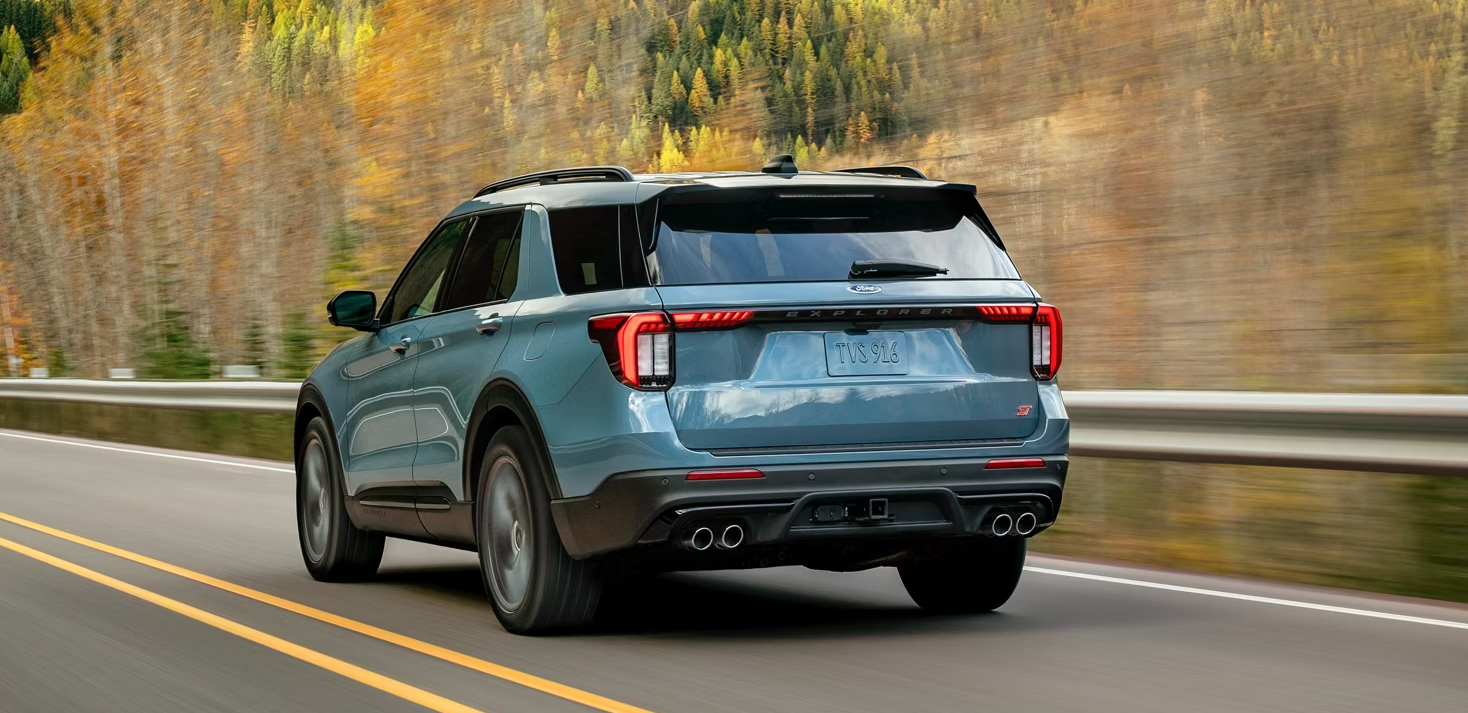
Find your ideal 2026 Ford Explorer trim — from the fuel-efficient base 2.3L EcoBoost to the hybrid — at Sarasota Ford.
City vs. Highway MPG: Making Sense of the Numbers
The 2026 Explorer’s highway numbers are significantly better than city ratings. In city driving, every stop wastes energy as heat, and restarting from zero uses a large burst of fuel. On highways, your Explorer reaches a steady cruise speed and the engine operates at its most efficient point. For the 2.3L EcoBoost with RWD, that difference is nearly 50% — 20 city vs. 29 highway MPG.
| Engine & Drivetrain | City MPG | Highway MPG | Combined MPG | Efficiency Gain |
|---|---|---|---|---|
| 2.3L EcoBoost RWD | 20 | 29 | 24 | +45% |
| 2.3L EcoBoost AWD | 19 | 27 | 22 | +42% |
| 3.0L EcoBoost V6 RWD | 18 | 25 | 21 | +39% |
| 3.0L EcoBoost V6 AWD | 17 | 23 | 19 | +35% |
The combined rating — 24 MPG for the 2.3L RWD — is the most realistic benchmark for most Sarasota-area drivers who mix downtown, suburban, and I-75 driving daily.
Proven Strategies to Maximize Your 2026 Explorer’s MPG
Small changes to your driving habits and maintenance routine can improve real-world fuel economy by 10–25%. Here are the strategies that make the biggest difference on Florida roads.
Smooth Acceleration & Braking
Gradual throttle inputs and early coasting to stops can improve MPG by 5–10% — and extends brake life at the same time.
Speed Management
Driving 65 mph vs. 75 mph can improve fuel economy by 10–15%. Use cruise control on flat highways to eliminate speed creep.
Proper Tire Inflation
Underinflated tires by just 5 PSI can reduce MPG by 1–3%. Check pressure monthly using the driver’s door jamb sticker for the correct PSI.
Use Built-In Technology
Auto Start-Stop saves fuel at every red light. Eco mode adjusts throttle response for better everyday efficiency.
| Efficiency Strategy | Potential MPG Improvement | Difficulty | Cost |
|---|---|---|---|
| Smooth acceleration & braking | 5–10% | Easy | Free |
| Reduce highway speed by 10 mph | 10–15% | Easy | Free |
| Maintain proper tire pressure | 1–3% | Easy | Free |
| Remove excess cargo & roof racks | 1–4% | Easy | Free |
| Regular maintenance schedule | 3–5% | Moderate | Standard service costs |
| Replace clogged air filter | Up to 10% | Easy | $15–30 |
| Use Auto Start-Stop Technology | 2–4% | Automatic | Free (built-in) |
Annual Fuel Cost Estimates for Sarasota Drivers
Based on 15,000 miles per year and $3.30/gallon — a realistic Sarasota baseline — here’s what each Explorer configuration will cost you annually at the pump.
| Explorer Configuration | Combined MPG | Annual Gallons (15K mi) | Annual Fuel Cost |
|---|---|---|---|
| 2.3L EcoBoost RWD | 24 mpg | 625 gallons | $2,063 |
| 2.3L EcoBoost 4WD | 23 mpg | 652 gallons | $2,152 |
| 3.0L EcoBoost RWD | 21 mpg | 714 gallons | $2,357 |
| 3.0L EcoBoost 4WD | 20 mpg | 750 gallons | $2,475 |
| Hybrid (estimated) | 28 mpg | 536 gallons | $1,768 |
The hybrid saves approximately $295 per year compared to the base 2.3L — $1,475 over five years at current prices. Drive more than 15,000 miles annually and those savings grow even faster.
How the 2026 Explorer’s MPG Compares to Competitors
The 2.3L EcoBoost’s 29 MPG highway rating is one of the best among non-hybrid three-row SUVs. See how it stacks up — and explore our full Explorer vs. Chevy Traverse comparison for a deeper look.
| Vehicle Model | City MPG | Highway MPG | Combined MPG | Engine Type |
|---|---|---|---|---|
| 2026 Ford Explorer (2.3L) | 20 | 29 | 24 | 2.3L EcoBoost Turbo I-4 |
| Chevrolet Traverse | 18 | 27 | 21 | 3.6L V6 |
| Honda Pilot | 20 | 27 | 23 | 3.5L V6 |
| Nissan Pathfinder | 20 | 27 | 23 | 3.5L V6 |
| Toyota Highlander Hybrid | 36 | 35 | 36 | 2.5L Hybrid I-4 |
Beyond fuel economy, the Explorer brings class-leading towing capacity up to 5,600 lbs, Ford’s advanced SYNC technology, and a wide range of trims. Browse available models on our Ford Explorer inventory page.
Experience the 2026 Ford Explorer’s Efficiency at Sarasota Ford
We serve drivers across Sarasota, Bradenton, Venice, and all of Southwest Florida. Call us at 888-349-4989 or visit our showroom at 707 S Washington Blvd, Sarasota, FL 34236.
2026 Ford Explorer MPG — Frequently Asked Questions
What is the fuel economy of the 2026 Ford Explorer with the base engine?
The 2026 Ford Explorer with the 2.3L EcoBoost engine and rear-wheel drive gets 20 MPG city, 29 MPG highway, and 24 MPG combined — the most fuel-efficient gasoline-powered Explorer and one of the best in its class for highway driving.
How does the 2026 Ford Explorer hybrid MPG compare to gas-only models?
The hybrid is expected to deliver significantly better fuel economy — especially in city driving. Hybrid owners in comparable conditions are reporting 25–28 MPG combined, versus 24 MPG for the base 2.3L. The annual savings can reach $295 or more at current Sarasota fuel prices.
Does adding four-wheel drive significantly hurt fuel economy?
Only slightly. The 2.3L RWD gets 20/29/24 MPG, while the 4WD version gets 20/27/23 — just one MPG less combined. This makes 4WD a practical choice for those who want extra traction without a meaningful fuel economy penalty.
How much will I spend on gas annually with a 2026 Ford Explorer?
Based on 15,000 miles and $3.30/gallon: the 2.3L RWD runs about $2,063/year, the 2.3L 4WD about $2,152, the 3.0L RWD about $2,357, the 3.0L 4WD about $2,475, and the hybrid an estimated $1,768. We can run a personalized estimate at Sarasota Ford based on your actual driving habits.
Should I choose the 2.3-liter or 3.0-liter EcoBoost for better fuel economy?
If fuel economy is your priority, choose the 2.3L EcoBoost — up to 29 MPG highway with 300 horsepower, plenty for daily driving and light towing. The 3.0L V6 gives you 400 hp but sacrifices 2–4 MPG. Choose the V6 if you need maximum towing power or want the most performance the Explorer offers.
Does the 2026 Ford Explorer Tremor get worse gas mileage than regular models?
Yes, slightly. The Tremor with the 2.3L gets 19/23/21 MPG, and with the 3.0L gets 17/22/19 MPG — a small reduction due to its off-road-focused setup. A reasonable trade-off for families who want serious off-road capability.
Will using premium gasoline improve my 2026 Explorer’s fuel economy?
No. Ford engineers designed the Explorer’s EcoBoost engines to run optimally on regular 87-octane gasoline. Using premium fuel provides no efficiency or performance benefit — it’s simply a waste of money.
How does air conditioning affect fuel economy in Florida?
Running the A/C can reduce fuel economy by 2–4 MPG. You can minimize the impact by parking in shade, using recirculation mode once the cabin is cool, and setting a comfortable temperature. The hybrid’s electric motor helps offset some of this penalty in city driving.
Can towing with my 2026 Explorer significantly reduce fuel economy?
Yes. Towing a boat or camper can drop real-world fuel economy to 12–16 MPG depending on the load. Despite this, the Explorer remains one of the class’s top towing vehicles with a maximum capacity of up to 5,600 lbs when properly equipped.
What maintenance services help maximize fuel efficiency?
Regular oil changes with the correct grade reduce friction and improve MPG by 1–2%. A clean air filter can improve efficiency by up to 10%. Tire rotations, alignments, and proper inflation all reduce rolling resistance. Our Ford-certified technicians at Sarasota Ford follow Ford’s recommended maintenance schedule to keep your Explorer running at peak efficiency.
Connect with us